
MoneylineFinTech2026
One open-source platform for every financial document a funder reads
180+ API endpoints across ingest, classify, parse, enrich, evaluate, and relay. 50+ document types from bank statements to ACORD forms. MCP server, CLI, SDKs, dashboard, visual workflow builder. Self-hostable on Docker, Kubernetes, or a single binary.
- Engineering
- AI Engineering
- Product Design
Client
Moneyline
Industry
FinTech
Deliverables
- Six-service core platform behind a Kong API gateway
- 180+ endpoint REST API with TypeScript + Python SDKs and CLI
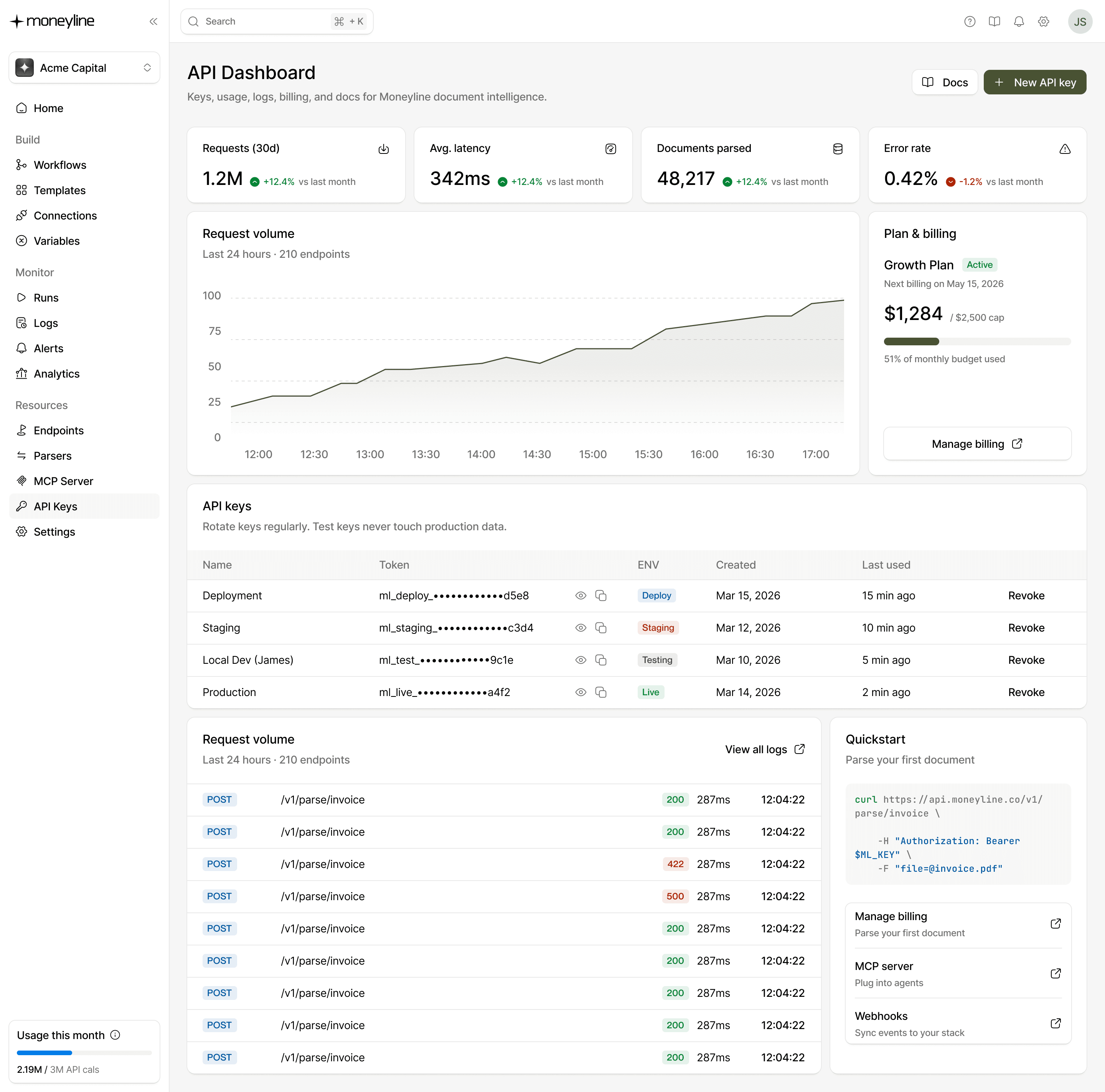
- Operator dashboard with multi-environment API keys + usage billing
Year
2026
Overview
Moneyline is the open-source alternative to Heron Data, Ocrolus, and Inscribe, built for the AI era. Funders, brokers, and finance ops teams send every financial document a customer puts in front of them (bank statements, tax returns, ISO applications, ACORD forms) through one pipeline: ingest, classify, parse, enrich, evaluate, relay. Developers reach for the API, SDKs, and MCP server. Operators reach for the dashboard and the visual workflow builder. AI agents reach for the function-calling schemas. One engine, three buyers, same primitives underneath.
The challenge
Three real buyers want different surfaces of the same engine. The developer wants a Stripe-quality REST API with typed SDKs and a CLI; the finance ops lead wants a no-code workflow she can wire on a Tuesday afternoon; the AI agent wants function-calling schemas it can call without a human in the loop. Most document-AI vendors pick one buyer and lose the other two. On top of that, 50+ document types means schema variety is unbounded, and the product has to ship open-source AND hold an enterprise security posture (SOC 2, RBAC, SSO, encryption at rest and in transit, audit logs) that competes head-on with closed-source incumbents.
What we built
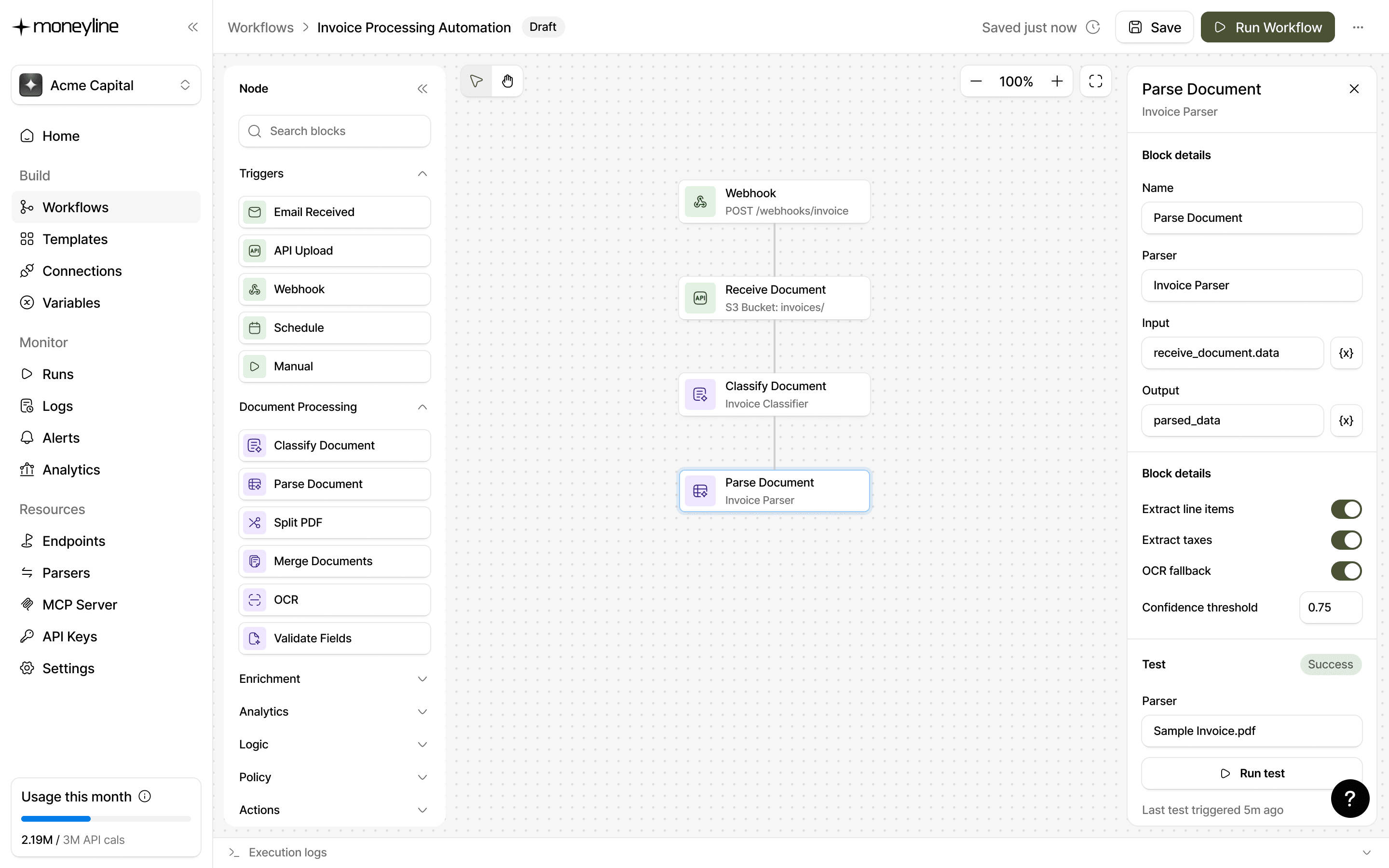
Six bounded-context services sit behind one Kong API gateway: Ingest, Classify, Parse, Enrich, Evaluate, Relay. Every surface (REST API, CLI, TypeScript and Python SDKs, MCP server, dashboard, workflow builder) calls the same six services, so a workflow node and an API endpoint and an MCP tool are three faces of the same primitive. The Fastify core handles routing and auth; a Python + FastAPI sidecar runs the ML pipeline because the parsing models live there. Postgres 16 with pgvector carries documents, embeddings, and the analytics engine in one store. The workflow builder is a typed canvas with 20+ node types (triggers, document processing, enrichment, analytics, logic, actions) and per-block confidence thresholds and OCR fallback. Self-hosting ships as Docker compose, Kubernetes manifests, and a single-binary build because each deployment target has a different buyer.
“180 endpoints don't matter if the dashboard isn't fast and the workflow builder doesn't make sense to a non-developer. The bar was Stripe-quality on the API and Linear-quality on the UI; everything else followed from that.”
Delivered
- 01Six-service core platform behind a Kong API gateway
- 02180+ endpoint REST API with TypeScript + Python SDKs and CLI
- 03Operator dashboard with multi-environment API keys + usage billing
- 04Visual workflow builder with 20+ node types
- 05MCP server exposing every workflow node as an agent-callable tool
- 06Self-hosting deploy targets: Docker, Kubernetes, single binary
- 07Enterprise auth + RBAC + SSO + audit log
Integrations
8 services
Anthropic
Classification + parsing models
OpenAI
OCR fallback + embeddings
Kong
API gateway
Ory Kratos + Keto
Auth, identity, and permissions
pgvector
Document embeddings + semantic search
MinIO / S3
Document storage
Stripe
Usage-based billing
Sentry
Error monitoring
Tech stack
Posts that connect to this work.
Building something similar?
30 minutes to walk through your roadmap, what's blocking you, and whether we're a fit. No pitch deck.